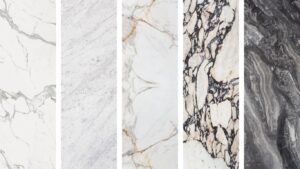


Carrara marble and Calacatta marble are two of the best-known natural stones in Italian marble. At first glance, they may appear similar, but there are clear differences between them.
In this article, we explain the key differences between these two white marbles differ and which one may be best suited to the style and needs of each space.
Contents
What is the main differences between Carrara and Calacatta marble?
Although both originate from Italy and share the same geographical provenance, their appearance and characteristics differ significantly. Understanding these distinctions makes it possible to select the most suitable marble according to the type of project. It also helps adapt the stone to the style of the space and the desired level of visual impact.
Calacatta Marble
Aesthetics
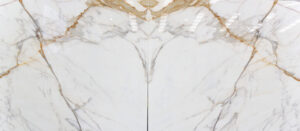
Calacatta marble features a bright, luminous white background with gray veining and subtle golden nuances.
It’s important to note that the aesthetic appearance can vary considerably depending on the specific type of Calacatta, as this family encompasses a wide range of varieties, each with its own distinct character in terms of veining intensity, contrast, pattern distribution, and color.
Origin
The same Italian quarries that have brought worldwide recognition to Carrara marble are also the source of Calacatta marble.
Unlike Carrara, Calacatta is extracted from more limited and specific areas within these quarries, which explains its lower availability and its status as a more exclusive material. Its geological formation and the particular mineral conditions of each deposit are responsible for its bold veining and its distinctive bright white background.
Applications
Calacatta marble is primarily used in projects where aesthetics play a leading role. It is commonly in wall cladding, interior flooring, bathrooms, and decorative elements. In recent years, its use in countertops has also increased, particularly in projects where exclusivity and design take precedence over practicality. However, it should be noted that, as a white marble, it is not the material we most recommend for high-traffic or intensive-use areas unless careful and consistent maintenance is anticipated.
Due to the strong visual impact of its veining, installers typically position Calacatta slabs to highlight the stone´s natural pattern. Designers often use bookmatching, pairing slabs symmetrically so the veining flows seamlessly from one piece to the next and creates continuous, visually striking compositions.

Varieties
The Calacatta marble family encompasses several distinct varieties. Among the most notable are:
- Calacatta Gold: In addition to pure Calacatta, this is one of the most highly valued and recognized varieties. Calacatta Gold marble is distinguished by its luminous white background with gray and golden veining. Discover our selection of blocks.

- Calacatta Borghini: This variety is very similar to Calacatta Gold; the difference between them is primarily commercial and aesthetic in nature. Explore our available blocks.

- Calacatta Viola: A distinctive variety with strong character, recognized for its brecciated veining in shades of purple, burgundy, and violet. In recent years, Calacatta Viola has gained significant prominence in high-end interior design projects. Find inspiration in our selection of blocks.

Carrara Marble
Aesthetics
Carrara marble is characterized by its white background with a grayish hue and finer veining compared to Calacatta. Its veins display a more subtle and continuous pattern, which facilitates its integration into projects without creating an excessive visual impact.
Thanks to its balanced aesthetic and compact structure, architects widely use Carrara marble to clad large surfaces, achieving visual uniformity and continuity without overwhelming the space.

Origin
Sourced from the historic quarries of Carrara in the Tuscany region of Italy, this marble boasts a history spanning thousands of years. Used since the time of the Roman Empire and widely employed during the Renaissance by artists such as Michelangelo, it has established itself as the benchmark white marble worldwide.
Its historically broad availability and the extensive nature of its deposits make it a highly functional and accessible option for a wide range of projects.
Applications
Thanks to its more uniform appearance and greater availability, Carrara marble is a very versatile material. It is commonly used for interior flooring, cladding, bathrooms, staircases, and architectural elements.


Varieties
In the case of Carrara marble, rather than referring to distinct varieties, it is more appropriate to speak of different grades, determined by the purity of its background, the fineness of its grain, and the regularity of its veining.
Generally speaking, the more homogeneous, clean, and luminous the background, the higher the grade of Carrara marble. Conversely, a greater presence of veining and a more pronounced grayish background typically correspond to lower and more economical grades.
Which is the most prestigious marble?
The concept of “prestige” can be analyzed according to different criteria.
From the standpoint of exclusivity and decorative value, Calacatta marble is generally regarded as the more prestigious option. Its more limited availability, extraction from specific areas, and bolder, more dramatic veining associate it with high-end projects and luxury design.
Carrara marble, on the other hand, stands out for its long historical tradition. Used since Ancient Rome in sculptures and monumental works, it has become an absolute benchmark of white marble worldwide.
From the standpoint of exclusivity and decorative value, many designers regard Calacatta marble as the more prestigious option. Calacatta typically commands a higher price. By contrast, Carrara marble is more affordable and widely used in large-scale projects such as shopping centers, hotels, public buildings, and residential developments. This broad adoption makes it a highly versatile and functional choice, but it also reduces its exclusive character compared to Calacatta.
From a strictly economic and market positioning perspective, the market considers Calacatta the more prestigious marble, while Carrara stands out for its accessibility and versatility.
Both materials represent the excellence of Italian marble. If you would like to learn more about Italian marbles, we invite you to explore our comprehensive guide.
Which one to choose?
Choosing between Calacatta marble and Carrara marble is not about determining which one is “better”; the key lies in understanding what each material contributes and how it fits within the overall concept of the project.
The decision should be based on objective criteria such as:
- The aesthetic concept to be conveyed.
- The level of prominence the surface will have within the space.
- The available budget.
- The intended use and required technical performance.
- The type of space.
Ultimately, the choice does not depend solely on prestige or cost, but on how the material interacts with the space, the architectural style, and the technical requirements of the project. Good design is not about selecting the most exclusive marble, but the most appropriate one.
If you have reached this point and are still uncertain, below we summarize the main differences to help you make an informed decision:

At Fiorantina Stone, we have a highly qualified team ready to provide personalized guidance to help you select the natural stone that best suits your project, taking into account aesthetic, technical, and budgetary considerations. We invite you to share your questions with us through our contact form.