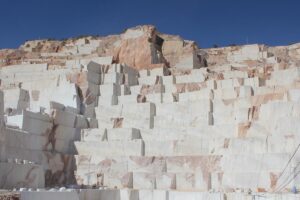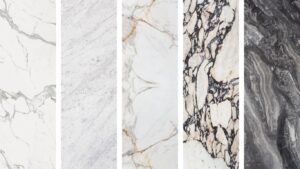

When we think of marble, it is easy to picture the historic quarries of Italy or Greece. However, Spain is home to some of the world’s most important marble quarries and an extraordinary variety of natural stones renowned for their beauty, quality, and versatility. From the timeless elegance of Crema Marfil to the rich tones of Rojo Alicante and the striking sophistication of Negro Marquina, Spanish marbles have been used for decades in luxury hotels, iconic buildings, public spaces, and prestigious architecture and interior design projects across the globe.
In this comprehensive guide, you’ll discover some of the most iconic varieties of Spanish natural stone and the unique characteristics that have made them benchmarks in architecture and interior design worldwide.

Contents
Spanish marbles: tradition, quality and beauty
The geological richness of the Iberian Peninsula has given rise to an extraordinary variety of marbles, each distinguished by its own colors, veining patterns, and physical properties. From warm beige tones to deep blacks, Spanish marbles offer versatile solutions for every type of architectural and interior design project.
Their durability, versatility, and timeless beauty have made Spanish marbles the preferred choice for prestigious projects around the world, establishing Spain as one of the leading countries in the global natural stone industry.
Crema Marfil
Crema Marfil is undoubtedly one of the most renowned and highly regarded Spanish marbles worldwide. It is primarily quarried in Pinoso, in the province of Alicante—home to some of the largest Crema Marfil deposits—as well as in several quarries in the neighboring province of Murcia. Thanks to the scale of these reserves, Crema Marfil offers an outstanding supply capacity, making it an ideal choice for large-scale architectural and construction projects.
Its distinctive beige background is enhanced by subtle veining and minimal natural variation. These features give Crema Marfil a timeless elegance. They also allow it to complement a wide range of architectural styles, color palettes, and materials.
Its versatility is another key advantage. Combined with its warm and sophisticated appearance, it has made Crema Marfil an icon of Spanish natural stone. Today, it can be found in residential developments, luxury hotels, commercial buildings, and public spaces around the world.
You’ve probably seen this elegant beige marble before. It has been used in countless façades and flooring projects across Spain. Two of the best-known examples are La Fe University and Polytechnic Hospital in Valencia and the iconic Explanada de España in Alicante. The promenade’s distinctive wave-patterned pavement blends Crema Marfil, Rojo Alicante, and Negro Marquina. The result is one of the most iconic natural stone mosaics in Spain.
The most common uses for Cream Marfil marble are: wall cladding in general, flooring, staircases, bathrooms, and outdoor areas.


Projects featuring Crema Marfil: flooring and stair cladding.
Rojo Alicante
Red Alicante marble, quarried in the municipalities of Monóvar and La Romana in the province of Alicante, is one of Spain’s most distinctive natural stones and a highly recognizable material on the international stage.
It is considered one of the most characterful Spanish marble varieties, defined by its deep reddish background crossed by elegant white and ivory veining. This natural contrast gives the stone a strong visual identity, adding warmth and a unique Mediterranean aesthetic to any space.
Thanks to its intense color and striking appearance, Rojo Alicante has been used in architectural projects for decades. It is also featured in historic buildings and monuments, where it is valued for its decorative impact and timeless appeal.

Explanada de Alicante: Rojo Alicante, Negro Marquina, and Crema Marfil.
Currently, Rojo Alicante is used for wall cladding, staircases, columns, bathrooms, and decorative elements. Beyond its natural beauty and great durability, it is a material capable of conveying character and a strong visual identity.

Project with Rojo Alicante: bathroom.
Negro Marquina
Originating from northern Spain, Negro Marquina marble is a true classic within the world of natural stone. Timeless and full of character, it is defined by its deep, intense black background crossed by elegant white veining.
Each block features a unique distribution of veins, varying in thickness, intensity, and direction, which results in one-of-a-kind pieces. This natural variability, combined with its refined and timeless elegance, has made Negro Marquina a consistently preferred choice for a wide range of architectural and interior design projects.
Its distinctive white veining makes it an excellent choice for bookmatching (open book) applications. When mirrored slabs are placed together, they create striking symmetrical patterns. The result is a highly decorative and visually impressive surface..

Open-book of Negro Marquina.
In recent years, this marble has gained even greater prominence, driven by design trends that emphasize bold contrasts and strong visual impact. Architects and designers frequently choose this marble for bathrooms, wall cladding, fireplaces, staircases, and bespoke furniture pieces.


Projects Featuring Negro Marquina: Fireplace Cladding, Stairs, and Bathrooms.
Dark Emperador
Few natural stones have remained as consistently relevant over time as Dark Emperador marble, also known as Marrón Imperial. Its distinctive combination of deep brown tones and lighter veining has established this material as a benchmark in architecture and interior design, featuring in projects around the world for decades.
Its natural aesthetic blends seamlessly with a wide range of materials and finishes, from wood to metal. This versatility makes Dark Emperador an excellent choice for many design styles.
Dark Emperador is widely used for staircases, bathrooms, flooring, and decorative features. Its rich color adds depth and sophistication to any space.


Project with Dark Emperador: Bathroom.
Light Emperador
Light Emperador marble is one of the most versatile varieties within the Emperador family. Its light brown background, complemented by subtle lighter veining, creates an elegant and luminous aesthetic that adapts easily to a wide range of interior design styles.
Unlike the deeper and more intense tones of Dark Emperador (Marrón Imperial), Light Emperador offers a softer and more balanced surface, ideal for creating warm and inviting spaces. Its natural tone pairs perfectly with light woods, metals, and neutral finishes, enhancing both contemporary and classic designs.
It is commonly used in wall cladding, flooring, bathrooms, staircases, and bespoke furniture pieces.


Projects featuring Light Emperador: flooring and table.
Armani Bronze/ Pulpis
Armani Bronze, also known as Gris Pulpis, stands out for its elegant and highly contemporary “toffee” color—a warm brown tone enriched with golden and caramel undertones. Refined veining gives this brown marble natural movement and remarkable depth.
Its combination of elegance and modernity makes it a popular choice for contemporary architecture and interior design. It is frequently used for wall cladding, flooring, bathrooms, common areas, and decorative features. In every setting, it enhances the space with its refined natural beauty. Its reliable supply capacity has also supported its use in large-scale projects.
Notable examples of its application include the Oceanogràfic of Valencia, the Museo del Prado, and retail spaces of the international fashion brand Zara.
Beyond trends, Armani Bronze stands out for its ability to add visual depth, character, and elegance to any space.


Project featuring Armani Bronze: wall and bathroom cladding.
Crema Valencia
The beauty of Crema Valencia marble lies in its warm color palette. Its creamy orange background is complemented by subtle reddish veining. This combination creates an elegant and well-balanced surface. It brings warmth and harmony to any space while highlighting the stone’s natural beauty.
Its timeless aesthetic allows Crema Valencia to complement a wide range of design styles. It works equally well in traditional projects and contemporary spaces that seek a neutral yet sophisticated look.
Its versatility is one of its greatest strengths. Combined with its natural character, it has made Crema Valencia a popular choice for flooring, wall cladding, staircases, and large-format applications.


Projects Featuring Crema Valencia: wall cladding, fireplaces, and craftmanship.
Spanish marble: a global benchmark
For centuries, Spain has been renowned for its exceptional natural stone. Its rich geological resources, combined with a long tradition of extraction and craftsmanship, have earned Spanish marble a place among the world’s most prestigious natural stones, alongside Italian marble. Its exceptional quality, technical performance, and long-lasting durability have earned it an outstanding international reputation.
However, Spain’s geological wealth extends far beyond marble. The country is also home to significant deposits of granite, limestone, sandstone, and other natural stones that supply projects across all five continents. This positions Spain as one of the leading producers and exporters of natural stone worldwide. At Fiorantina Stone, we work with materials sourced from leading natural stone-producing countries, carefully selecting marbles, onyx, quartzites, granites, and other stones from around the world. However, Spanish materials hold a very special place within our collection. Their proximity to our facilities allows us to maintain consistent availability while offering in-depth knowledge of each material’s characteristics, performance, and applications.