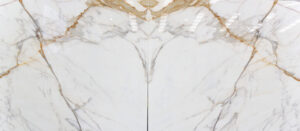


When it comes time to choose materials for a project, one of the most common questions is whether to opt for natural marble stone or marble-look porcelain, two materials with very different characteristics.
Both are used in flooring, bathrooms, kitchens, and wall cladding. Synthetic materials imitate natural ones; however, behind this appearance lie significant differences that influence the final outcome of the space.
Contents
What should you bear in mind when comparing different materials?
When comparing natural stone with marble-effect porcelain tiles, it is important to consider a number of factors that go beyond the design.
Marble is a natural stone formed over millions of years through unique geological processes. Each block extracted from the quarry features its own distinct veins, hues, minerals, variations and unique composition, which means that no two pieces are alike. This singularity is one of its greatest assets: every project created using marble is, by definition, unique and one-of-a-kind. It is precisely for this reason that synthetic materials such as porcelain stoneware seek to replicate its aesthetic, attempting to imitate something that, by its essence, cannot be replicated.
Marble-effect porcelain tiles are an industrially manufactured ceramic material that replicates the visual appearance of marble using printing techniques applied to the surface of the tile.
Understanding this difference helps us appreciate why the end result is not just a question of aesthetics, but also of value, authenticity and character.
In addition to the material’s origin, it is also worth considering factors such as its application, durability, how it ages over time, and the aesthetic value it adds to the project as a whole.
Comparison based on applications
Natural stone and marble-look porcelain can be used on many surfaces, such as floors, bathrooms, showers, or wall cladding. However, the difference between the two materials becomes evident in the final result, installation method, maintenance, and durability.
Porcelain reproduces the look of marble through digital printing, creating a uniform design manufactured industrially. Marble, on the other hand, is a natural stone: each block extracted from the quarry features its own veining, nuances, and variations, making every piece unique.


This difference is especially noticeable in large spaces, where marble creates a more natural continuity and adds a unique value. Moreover, in projects where a more authentic finish with character is desired, it is often the preferred option for architects and designers, as it brings added value.
Porcelain, on the other hand, stands out in applications where resistance, lower installation costs, and design uniformity for future piece replacement are prioritized.
Ultimately, the choice between one or the other will depend on the balance you want to achieve between aesthetics, functionality, and budget.
Marble vs. porcelain cost
Talking about cost means understanding the origin of both materials. A mass-produced material cannot have the same value as one extracted directly from nature, formed over millions of years.
When you choose marble, you are incorporating into your space a piece that comes from a quarry in countries such as Italy, Brazil, or Mexico… with everything that implies in terms of extraction, selection, and transport. Therefore, it is not simply a material, but an element with origin, journey, and singularity. What you are bringing into the project is not just a surface covering, but a unique fragment of nature.
Marble-look porcelain, on the other hand, is an industrially manufactured material. Its design is applied through digital printing, resulting in a decorated surface that, although it imitates the aesthetics of marble, remains a graphic reproduction. In many cases, this can be noticed in the repetition of patterns and the lack of depth inherent to natural stone.
This difference in the process is key to understanding the value of each material. While porcelain is produced in series, natural stone is a limited natural resource, whose availability depends on quarry extraction and the characteristics of each block. Even so, it is important to note that this difference does not always translate into a higher price: in many cases, porcelain can reach (and even exceed) the cost of certain natural materials.
In general terms, porcelain tends to fall within a more accessible price range, while marble shows greater price variability depending on the type of stone, its origin, and its selection.
Durability of marble and porcelain
Durability is one of the key factors when choosing a material for any type of project, especially for surfaces such as floors or cladding that are exposed to daily use.
Marble, being a natural stone, stands out for its ability to last for decades and even generations. It is a material that ages well and, with proper care, can recover its original shine and aesthetic through specific treatments. For this reason, it is considered a highly valued option in projects where a long-lasting finish with character is desired.
Porcelain, on the other hand, stands out for its resistance to wear and its low water absorption. However, as it is an artificial material, when it suffers a break, crack, or chip, repair options are limited and, in most cases, involve replacing the entire piece in order to maintain a good aesthetic result.


In contrast, natural stone such as marble offers a greater capacity for restoration. Being a solid material, it can be worked and refurbished even after installation. Over time, or when signs of wear appear, processes such as re-polishing can be carried out, restoring the surface to its original appearance. In addition, small cracks or imperfections can be treated using specific techniques without the need to replace the entire piece. This ability to be restored not only extends the material’s lifespan but also reinforces its long-term value compared to other alternatives.
Which one should I choose: marble or marble-look porcelain?
Two materials, two natures, two ways of understanding the final result. Choosing a material is no longer just an aesthetic decision. Factors such as sustainability, durability, and how the material performs over time are increasingly taken into account.
In this sense, natural marble offers important advantages. It is a material obtained directly from nature, without the need for complex chemical processes, which makes it a natural and recyclable option. Porcelain, on the other hand, requires firing at very high temperatures, involving higher energy consumption and greater industrial waste generation. In terms of figures, average emissions in marble production are around 50–150 kg CO₂/m², while synthetic or porcelain materials range between 200–400 kg CO₂/m².
Another relevant aspect in terms of sustainability is the material’s behavior at the end of its life cycle. Natural stone, such as marble, is a completely inert material, which means it does not release polluting substances or undergo chemical transformations over time. This allows it, once removed, to be crushed and reused as aggregate in construction or other applications, without the need for complex treatments. Natural stone does not become waste.
In contrast, synthetic materials such as porcelain, although recyclable in certain contexts, have a more complex composition due to the industrial processes, glazes, and additives used in their manufacture. This limits their direct reuse and reduces their versatility at the end of their life cycle.
Another aspect that reinforces its value is durability. Sustainability does not depend only on how a material is manufactured, but also on how long it remains in use. In this sense, the durability and restoration capacity of natural stone play a key role compared to materials that, when damaged, require replacement. Natural stone can have a lifespan of decades or even centuries.
In addition, marble contributes to the thermal comfort of spaces, as natural stone helps maintain more stable indoor temperatures, promoting more comfortable and energy-efficient environments. To all this, its unique character must be added: each piece features its own veining and variations, making every surface one of a kind.

In conclusion, the choice between natural marble and marble-look porcelain is not only a matter of appearance, but of concept. While one reproduces, the other is; while one imitates, the other brings authenticity, history, and value.
Choosing natural stone means selecting a material with origin, its own identity, and the ability to evolve over time while maintaining its essence. Because some decisions are not only seen, but felt in the quality, durability, and character they bring to each space.
At Fiorantina Stone, we work with carefully selected natural stone, designed for projects where the material does not only accompany the design, but defines it.