
In contemporary architecture and interior design, light has ceased to be a secondary element and has become a true design tool. Light not only defines atmospheres; it interacts with materials and transforms the perception of spaces. Giving lighting the importance it deserves is what elevates a good interior design project into one that truly makes a difference.
Within this context, designers have established the backlighting of natural stone as one of the most expressive lighting solutions. When designers conceive lighting from the outset and develop it in dialogue with materials, the result transcends pure functionality and turns the space into an experience.
Thanks to the development of increasingly efficient and precise LED lighting systems, it is now possible to enhance the translucency and depth of materials such as onyx, certain marbles, quartzites, or semi-precious stones like agate. These systems achieve visual effects that until just a few years ago seemed unthinkable. Applied to walls, staircases, countertops, or decorative elements, backlit stone makes it possible to create unique spaces. In these environments, material, light, and texture are seamlessly integrated without compromising the authenticity and inherent character of natural stone.

Kitchen island and countertop in backlit quartzite by Eleria Design
Contents
What type of stone can be backlit? The importance of lighting in interior design
As previously mentioned, translucent stone has become a key resource in interior design. It allows designers to bring both the space and the material to life through light, highlighting veining, transparency, and texture.
Through the careful selection of the appropriate natural stone and the right type of lighting, it is possible to create warm and inviting environments. Designers can also achieve cooler and brighter spaces in which the stone acts as the focal surface.
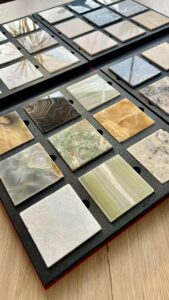
Onyx, quartzites, and certain marbles are materials that, due to their structure and composition, possess translucent qualities that make backlighting possible. However, not all stones respond to light in the same way.
The choice of material directly determines the final result. It influences the intensity and depth of the projected light, the degree of transparency, and the visual reading of veining and chromatic nuances. It also defines the atmosphere created within the space.
At this point, the natural stone supplier plays a decisive role. At Fiorantina Stone, we analyze each project individually and advise on the selection of the most suitable material for each application. Our goal is to ensure that backlighting enhances both the natural beauty of the stone and the overall concept of the project.
Backlit Onyx
Onyx is one of the most widely used materials in backlit natural stone projects. For this type of application, it is essential that the stone is translucent onyx, as there are opaque varieties that do not allow light to pass through. Most onyx stones have a crystalline structure that enables a high degree of light transmission.
One of the key advantages of onyx lies in its ability to adapt to different environments through the use of LED lighting in various color temperatures. In the case of neutral-toned onyx, especially white and ivory varieties, this versatility is significantly enhanced. The surface acts as a natural diffuser, allowing LED light in different colors to be projected through the stone and completely transforming the atmosphere. This flexibility offers dynamic and highly customizable solutions for each project.


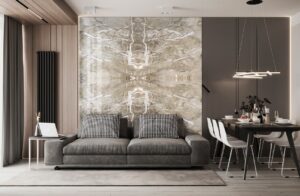
Backlit wall with multicolor LED system by Eleria Design
As can be seen in the images, a white material has been used—in this case, Blanco Namibia marble—and backlit using a multicolor LED system, which makes it possible to modify the light color and adapt the atmosphere accordingly.
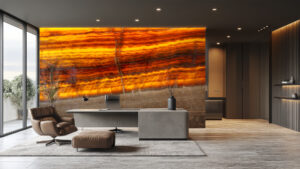
When the objective is to create warm and enveloping environments, white tones are usually set aside in favor of other color varieties. Stones with golden, amber, and honey hues enhance the sense of comfort and provide a warm, welcoming light. Notable options include Alabastrino Orange Onyx, Caramel Onyx, Cream Ivory Onyx, Sunset Onyx, Yellow Onyx, Lava Onyx, Orange Onyx, as well as the vibrant Arcobaleno Onyx, shown in the image below in a book-matched layout and backlit.

Backlit wall with Arcobaleno Onyx by Eleria Design
In projects that seek a cooler, more contemporary, or minimalist aesthetic, onyx in white, gray, or bluish tones is the most suitable choice. This type of material enhances the brightness of the space and reinforces a sense of openness.
Varieties such as White Onyx, Blue Onyx, White Crystal Onyx, Ocean Onyx, and Pearl Grey Onyx respond particularly well to lighting in neutral or cool white tones, allowing their translucency and subtle veining to be expressed with clarity and elegance.
Backlit marble
Translucent marble offers a more subtle backlighting effect due to its denser structure. Although its level of translucency is lower, backlighting enhances veining, stratification, and internal structures. This effect adds depth and a more refined visual reading to walls, panels, and architectural elements.
In projects where warm lighting is desired, most Portuguese marbles—such as Calacatta Rosenoir, Calacatta Portuguesa, and Rosa Portugues, among others—are particularly suitable, as the light they transmit tends to have a soft, warm, amber-toned quality.

Backlit Calacatta Rosenoir
By contrast, in cooler design concepts where white or neutral light is desired, white marbles are an excellent option. In this regard, marbles from Namibia are particularly well suited for backlighting, as they offer a strong and distinctive character thanks to the details present on their surface.
White Namibia, Oyster White, and Dover White—materials we work with regularly at Fiorantina Stone—are among our preferred choices for marble backlighting projects.

Backlit Dover White
Backlit quartzites
Quartzites have become one of the most highly valued options in architectural and interior design projects, especially in applications where high resistance is required without sacrificing aesthetic impact. Although quartzite is a natural stone of great hardness—comparable to granite—many varieties exhibit translucent qualities. The fact that a stone is translucent does not imply that it is a fragile material, and quartzites are a clear demonstration of this.
There are quartzites with partial translucency, featuring specific details or areas through which light can pass. Examples include Patagonia, Alpinus, and Alexandrita, materials that combine opaque zones with translucent ones, creating highly expressive contrasts. There are also quartzites that are almost 100% translucent, such as Cristallo Vitro, Cristallo Blue, and Cristalita Blue, which allow for a more uniform and continuous backlighting effect.

Backlit Patagonia kitchen by Bolleboom Keuken
Thanks to their high resistance and durability, these quartzites are in high demand for backlit kitchen projects. In these spaces, functionality and design work together. In varieties such as Patagonia and Alpinus, designers often find inclusions of translucent minerals such as aquamarine or brown tourmaline. These details add unique visual richness and give the backlighting a highly distinctive identity.
Semi-precious stones: agates and quartz
Agates and quartz are semi-precious stones that bring a high decorative value to luxury interior design projects. Their crystalline structure and mineral origin allow designers to approach the material from a more expressive perspective. As a result, each piece becomes a focal element. Agates stand out for their chromatic contrasts and strong visual impact, while quartz offers a more homogeneous and refined aesthetic.

Backlit Blue Agate
In this context, lighting ceases to be a secondary element and becomes an essential part of the project. Light not only complements the space, but also defines volumes, establishes hierarchies among surfaces, and shapes the perception of materials. In the case of translucent stone, backlighting makes it possible to approach interior design from a more sensory and experiential perspective.
Applications of translucent stone
Designers incorporate translucent stone into architectural and interior design projects as a resource that adds character and personality through light. Below are some of the most common applications of backlit stone:
Backlit staircases
The integration of light within natural stone transforms a purely functional element into a unique architectural feature. This effect can be clearly seen in backlit staircases.


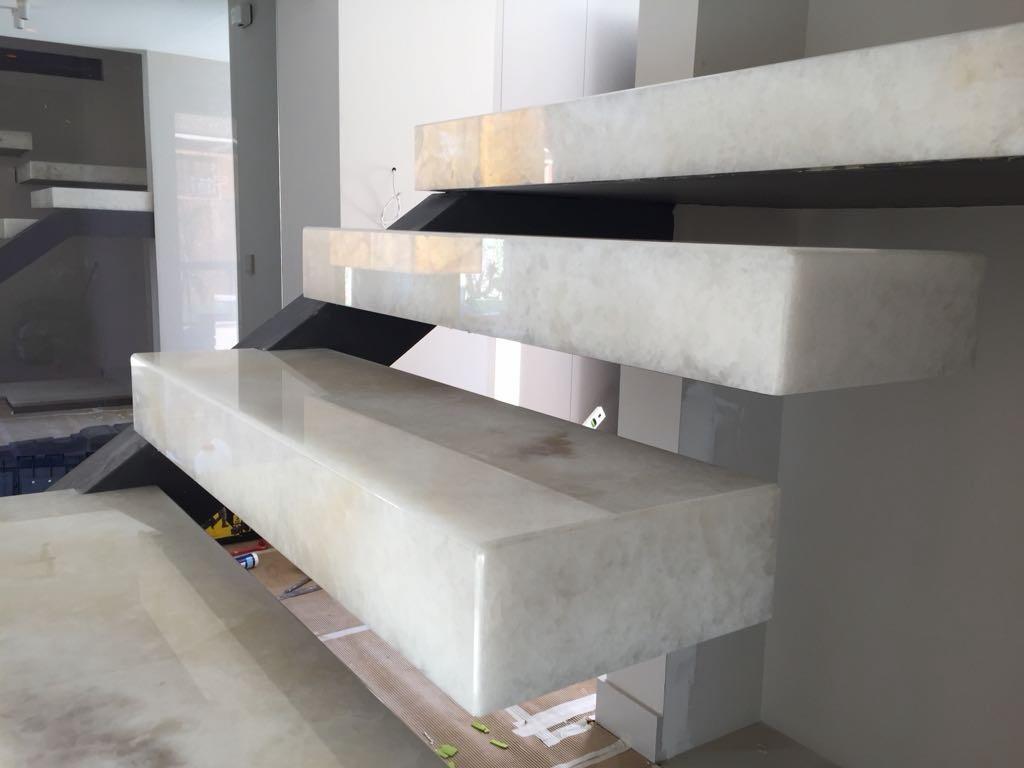

Onyx stairs without lighting vs. illuminated by Eleria Design
Backlit countertops and kitchen islands
In kitchens, translucent stone used for countertops and islands combines functionality and design. Backlighting highlights the natural grain and internal structure of the material, making these surfaces the focal point of the space.


Kitchens with backlit quartzite by Eleria Design
Bathrooms with backlit stone
In bathrooms, translucent stone contributes to create spaces with personality and makes them feel more spacious. Applied to walls, sink areas, or even showers, backlighting allows light to be integrated, turning surfaces into focal points and creating a relaxed atmosphere.


Natural stone backlit in bathroom by Eleria Design
Backlit walls and cladding
Backlit walls and cladding allow natural stone to be transformed into a lamp that is truly integrated into the space. The light, filtered through the material, enhances veins, textures, and depths, creating living surfaces that change according to the intensity a tone of the lighting.


Backlit onyx walls by Eleria Design
The importance of proper installation in backlit stone
The backlighting of natural stone does not depend exclusively on the choice of material. Precise technical execution plays an essential role in achieving an aesthetic and durable result.
In backlit stone projects, it is essential to have reliable natural stone suppliers and installation specialists.
A well-executed installation distributes light evenly, avoids shadows and unlit areas, prevents overheating, and ensures long-lasting performance. Specialized companies such as Eleria Design guarantee that the final result meets both technical and aesthetic criteria.


Backlit Tropical Onyx in Winery by Eleria Design
Technical keys to backlit stone
How is stone backlit?
Installers achieve backlighting by placing LED lighting systems behind the stone. This solution allows precise control of light intensity, tone, and uniformity. It also enhances the aesthetics of the material and extends the lifespan of the lighting system.
Specialized professionals play an essential role in this type of installation. As previously mentioned, Eleria Design is one of the leading companies in the development and implementation of backlighting systems for natural stone. We regularly collaborate with their team on projects where light and material must work together in perfect harmony.
Conclusion: balance between matter and light
Backlit stone represents a new way of understanding the connection between material and light in architecture and interior design. Integrating it into the stone itself lets you create more sensory spaces, where texture, color, and transparency take center stage.
When used wisely, backlit natural stone not only adds aesthetic value. It also becomes a resource that defines environments, creates identity, and reinforces the character of the space.